Highlights
- Janet helps manage a 120-cow farm alongside her husband, son, and daughter-in-law
- Her farm is notable for participating in Dairy Farmers of Canada’s Greenhouse Gas (GHG) Calculator pilot project, currently in its second round
Janet is a lifelong dairy farmer from Ontario whose career has been defined by blazing trails – both on her own operation and with other farms looking for sustainability solutions. Today, she’s part of a growing number of women helping shape the future of Canadian dairy.
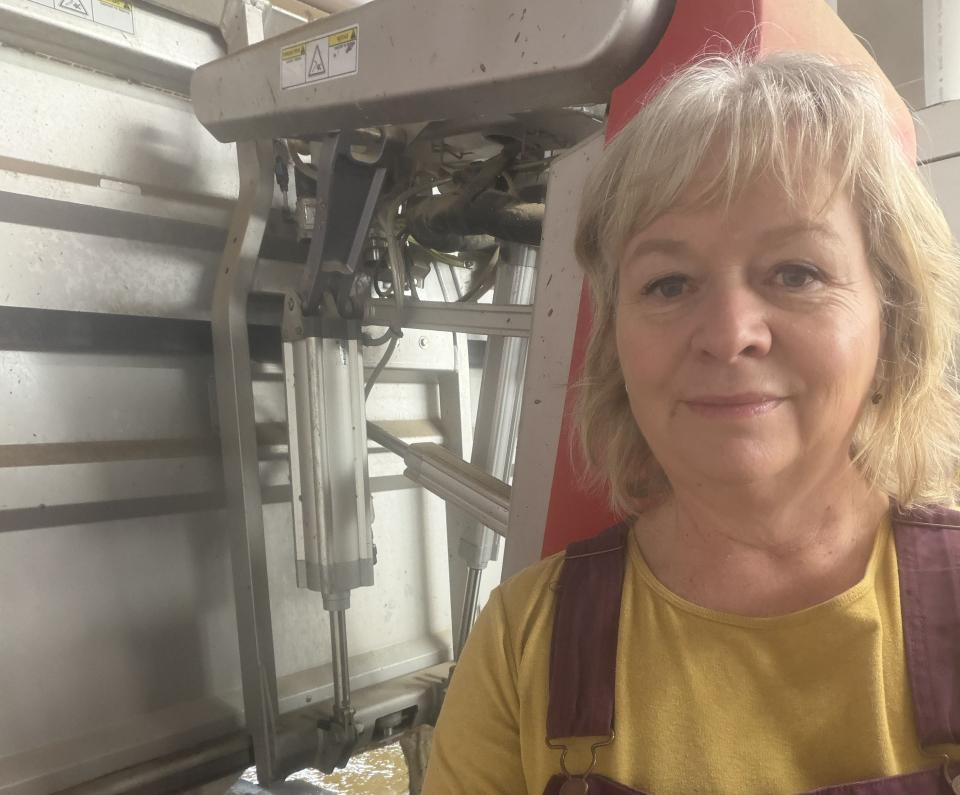
Janet drives sustainable solutions on her farm and across Ontario
Janet helps manage a 120-cow farm alongside her husband, son, and daughter-in-law, with the latter two in the process of becoming the farm’s fifth generation. Though she grew up on a dairy farm herself, her current operation was passed down to her husband and his brother as partners in the 1980s.
Janet’s farm is notable for participating in Dairy Farmers of Canada’s Greenhouse Gas (GHG) Calculator pilot project, currently in its second round. They were already working with the University of Guelph on a research study related to GHG measurement, so with a project underway and Janet’s expertise in data, joining DFC’s pilot project was an easy decision.
“I'm one of these crazy people who really like numbers,” she said. “Our farm was somewhat unique in that we could kind of layer the two [projects] and look at specific practices and see how they impacted not only emissions, but also the yield on that field.”
Janet participated in Round one of the GHG Calculator Pilot Project, which tested the Cool Farm Tool on farms across the country. Earlier this year, they returned for Round two, which provides Janet and the farm team with a comparison to Round one and allows them to test the tool’s next phase, called the Cool Farm Platform.
“It's really hard to know how we can move that needle on your farm when you don't know where you currently fit,” she said. “Being able to have a starting point will then help me know what difference a change in practice will make to my overall greenhouse gas output.”
It has already helped the farm team identify and adjust in areas such as nitrogen usage. This data can help the industry communicate a truer picture of what on-farm sustainability will look like, both to the agricultural community and the public.
“You need to be able to make sure from the agronomy perspective that you're still meeting the needs of the crop,” said Janet. “Farmers will want to reduce their greenhouse gas emissions because they know if it [carbon] is coming off their farm, it's not being utilized in the soil or by their plants, and that's costing them money.”
Janet said it also helps the public understand that fertilizer and manure use is data-driven and purposeful to avoid spreading too much. “People will say, ‘You're putting too much fertilizer in your field on purpose when we’re adding it to meet the needs of the plant.”
Janet also acts as an on-farm advisor for other operations in the GHG Calculator pilot project. On-farm advisors like Janet help participants collect data and calculate emissions based on factors such as herd size, feed ratio, manure management, crops, fuel use, transportation, and soil type. Janet says for some farms, an outside perspective is what’s needed to make progress.
“It's really understanding where you are benchmarking against others, seeing the areas of your farm that are higher than the average and trying to understand why they're higher,” she said.
“I know on our own farm, we'll have a third party come in occasionally. Sometimes they'll see something that we don't because we are walking by it every day.”
There’s a place for everyone in Canadian dairy
The value of new perspectives is something Janet appreciated early in her farming career. Growing up on her family farm, Janet always knew she wanted to work in dairy, but in a large family that included five brothers, she had to prove she could work just as hard and just as well.
"The perceived bias is still really frustrating to women who contribute significantly to the industry,” she said. “There have been assumptions made in a lot of different areas in agriculture as to who does what.”
Correcting these assumptions, which can still be ingrained in the work, takes an outside perspective.
“I had mentors who said, ‘You're more than capable. You're doing the right thing,’” said Janet.
This encouragement was what Janet says she needed as she jumped into discussions about finances and business analyses.
“I do see more women choosing agriculture for a career, which I think is great because the perspectives being brought into the industry are equally valuable. I always say, if you show that you're capable and you do the hard work, whatever gender you are, there's a job in agriculture for you.”
As more women step into leadership roles across Canadian dairy, farmers like Janet are proving that innovation, resilience, and a willingness to challenge assumptions are shaping the future of the industry. In this Year of the Woman Farmer, their stories are not only being told — they are helping define what comes next.